Indexly Usage Guide
Categories:
Overview
This guide explains how to use Indexly’s CLI tools to organize, index, search, analyze, and inspect local data.
It assumes:
- Indexly is installed
- Files are local and accessible
- You want repeatable, auditable workflows
For a high-level view of what Indexly can do and why, see: → Features Overview
Installation
You can install Indexly directly from PyPI:
pip install indexly
Or install all dependencies from the requirements file:
pip install -r requirements.txt
Or manually:
pip install nltk pymupdf pytesseract pillow python-docx openpyxl rapidfuzz fpdf2 reportlab \
beautifulsoup4 extract_msg eml-parser PyPDF2 watchdog colorama
📌 See Full Installation Guide for Windows tips.
2. 🗂️ Organizer – Automatic File Organization
Overview
The Organizer automatically sorts files, detects duplicates, and generates JSON logs.
Basic Command
indexly organize ~/Downloads --sort-by date
With Backup & Logs
indexly organize ~/Downloads \
  --sort-by extension \
  --backup ~/organizer-backups \
  --log-dir ~/organizer-logs
Listing & Duplicates
indexly organize ~/Downloads --lister --lister-duplicates
📌 Log Files: JSON logs are machine-readable and stored in
--log-dir. They support later Lister queries or automated pipelines.
3. 📋 Lister – Query Organizer Logs
Overview
Lister reads logs without rescanning the filesystem and allows filtering.
Example Commands
# List all JSON files
indexly lister ~/organizer-logs --ext .json

# Show duplicates
indexly lister ~/organizer-logs --duplicates
Filters:
--ext– file extension--category– custom categories--date YYYY-MM– organize by month--duplicates– list only duplicates
4. 💾 Backup & Restore
Backup Types
- Full – standalone snapshots
- Incremental – only changes since last backup
Examples
# Full backup
indexly backup ~/Documents

# Incremental backup
indexly backup ~/Documents --incremental

# Encrypted backup
indexly backup ~/Documents --encrypt
Restore Example
indexly restore incremental_2026-01-01_194042.tar.zst.enc \
  --target ~/restore \
  --decrypt
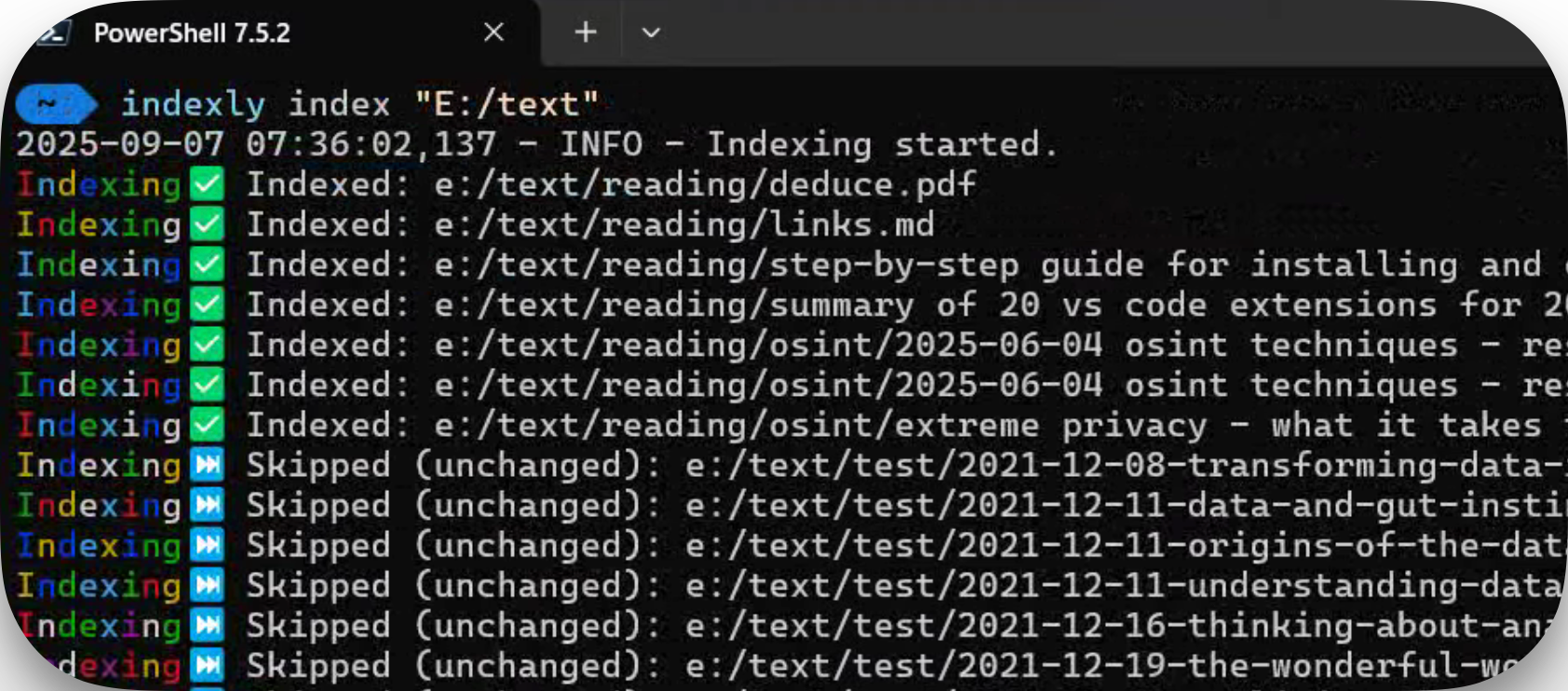
5. 📦 Indexing Files
Command
indexly index /path/to/folder --tag projectX
- Recursive indexing
- Attach tags for search filtering
- Supports all common file types
6. 🔍 Search & Regex
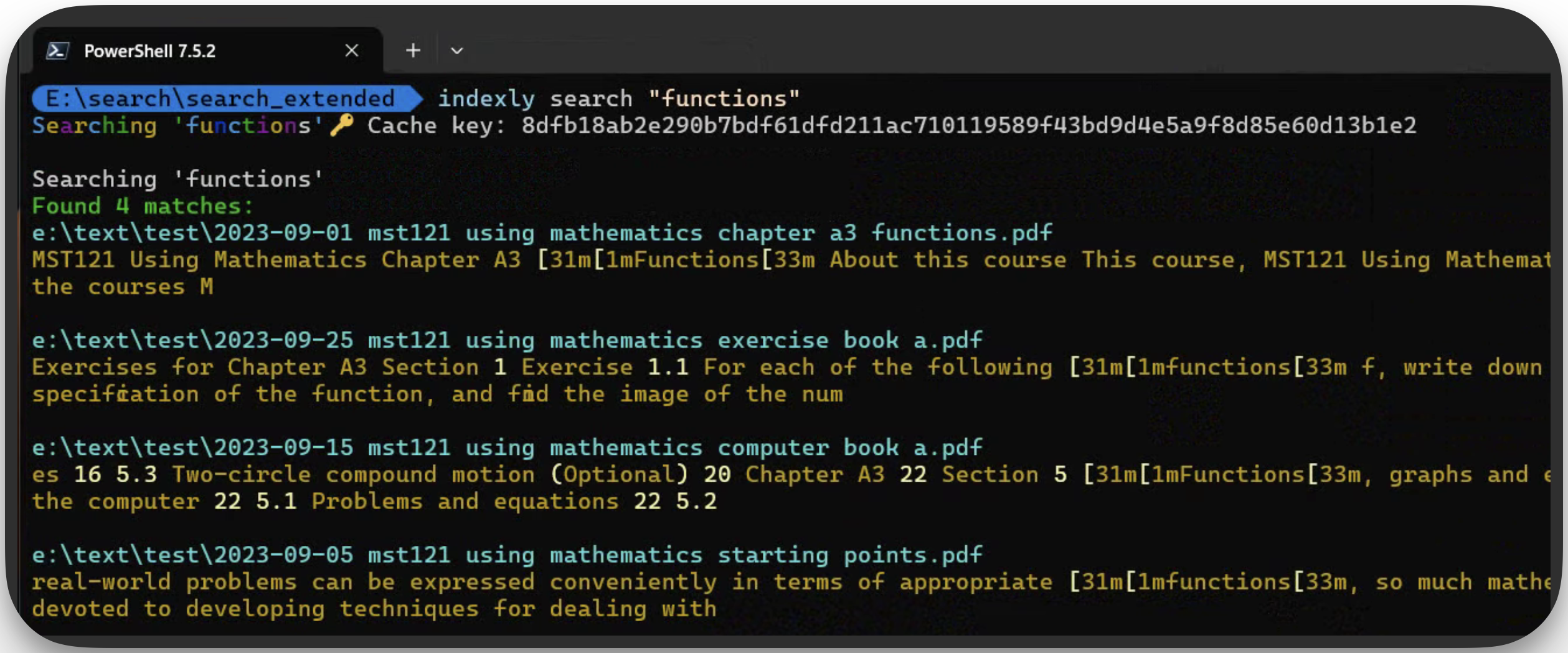
# Full-text search
indexly search "keyword"

# Regex search
indexly regex "pattern"

# Filter by tag
indexly search "keyword" --filter-tag urgent
Search Profiles:
# Save search profile
indexly search "budget" --save-profile q3_plans

# Reuse profile
indexly search "project plan" --profile q3_plans
7. 🏷️ Tagging
# Add tags
indexly tag add --files "/path/to/file.txt" --tags important

# Remove tags
indexly tag remove --files "/path/to/file.txt" --tags important

# List tags
indexly tag list --file "/path/to/file.txt"
Best Practices:
- Use lowercase, no spaces
- Use
--recursivefor folders - Tags immediately affect searches
8. 📊 Data Analysis
Supported Formats
| Format | Features |
|---|---|
| CSV | Auto-detect delimiters, statistics, IQR, etc. |
| JSON/NDJSON | Full JSON or NDJSON files |
| XLSX | Sheet auto-selection, table preview |
| SQLite DB | Table counts, numeric stats |
| XML | Tree inspection, XRechnung support |
| Parquet | Columnar-efficient loading |
Commands
indexly analyze-csv --file data.csv --format md --output summary.md
indexly analyze-file ./chinook.db --show-summary
indexly analyze-json data.ndjson
9. 📑 File & Folder Comparison
CLI Command
indexly compare path_a path_b [OPTIONS]
Options
| Option | Description |
|---|---|
--threshold THRESHOLD |
Similarity tolerance (0.0 exact, 1.0 very loose) |
--json |
Output results as JSON |
--quiet |
Suppress output (exit code only, useful for scripts) |
--extensions EXTENSIONS |
Comma-separated file extensions to include (e.g., .py,.json) |
--ignore IGNORE |
Comma-separated files/folders to ignore (e.g., .git,__pycache__) |
--context CONTEXT |
Lines of context to show around diffs (default: 3) |
--summary-only |
Show only summary for folders |
Exit Codes
| Code | Meaning |
|---|---|
| 0 | Files/folders identical |
| 1 | Differences detected |
| 2 | Invalid comparison (mismatched types, missing paths, errors) |
File Comparison Example
indexly compare blog-post.json "E:/text/test/data/titanic_01.json"
Output (with context folding example):
-           "item": "Batteries",
-           "quantity": 1,
-           "unit": "pack"
[dim]… 94 lines hidden[/dim]
+ {"PassengerId":"1","Survived":"0", ... }
+ {"PassengerId":"2","Survived":"1", ... }
Folder Comparison Example
indexly compare folder_a folder_b --summary-only
| Metric | Count |
|---|---|
| Identical | 12 |
| Similar | 3 |
| Modified | 5 |
| Missing A | 1 |
| Missing B | 2 |
10. 🧾 Exporting Results
# Export search or comparison results to PDF
indexly search "keyword" --export-format pdf --output result.pdf

# Export JSON for automation
indexly compare file_a.json file_b.json --json
11. ⚡ Quick Reference Cheat Sheet
| Task | Command |
|---|---|
| Organize files | indexly organize /path –sort-by date |
| List organized files | indexly lister /log/dir –ext .json |
| Backup | indexly backup /path –incremental –encrypt |
| Index files | indexly index /path –tag projectX |
| Search | indexly search “term” |
| Regex search | indexly regex “pattern” |
| Tag files | indexly tag add –files file.txt –tags urgent |
| Compare files/folders | indexly compare file_a file_b –context 5 |
| Export results | indexly search “term” –export-format pdf –output result.pdf |
12. ✅ Key Takeaways
✨ Organize & Backup – Safe, reversible, auditable
🔍 Search & Tag – Full-text, regex, fuzzy, filtered searches
📑 Compare – GitHub-style diffs, similarity scoring, context folding
📊 Analyze – CSV, JSON, DB stats
💾 Export – PDF, JSON, TXT
⚡ Performance – Smart caching, incremental indexing
🔒 Privacy & Safety – Runs locally; encrypted backups
Recommended Workflow: Organize → Backup → Index → Tag → Search → Compare → Export Use links to see detailed pages for Organizer, Lister, Backup, Compare.