Backup & Restore
Overview
Indexly provides a robust, incremental backup and restore system designed for reliability, transparency, and automation. It supports:
- Full and incremental backups
- Encrypted archives (
.enc) - Strong checksum verification
- Automatic scheduled backups
- Safe restore with chain reconstruction
Backups are optimized for long-term storage and predictable restores.
Backup Types
Full Backup
A full backup captures the entire folder state at a point in time.
indexly backup "E:\data"
- Required as the base for incrementals
- Self-contained
- Recommended periodically
Incremental Backup
Incremental backups store only changes since the last backup.
indexly backup "E:\data" --incremental
- Faster
- Smaller archives
- Requires restore chain
Indexly automatically determines the correct base.
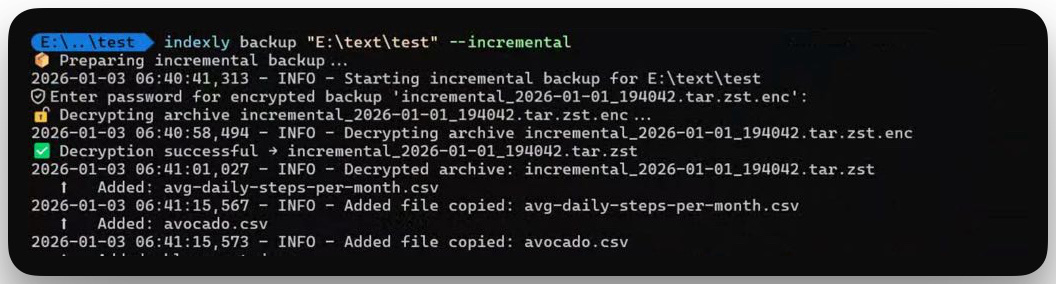
Encryption
Encrypted Backups
Backups can be encrypted using a password:
indexly backup "E:\data" --encrypt "Better-Password-2026"
If encryption support is not installed yet:
python -m pip install "indexly[backup]"
- Encryption happens after compression
- Resulting file ends with
.enc - Registry tracks encryption state
- Passwords must be at least 12 characters and include upper/lowercase letters, a digit, and a symbol
Example:
full_2026-01-01_191528.tar.zst.enc
The original archive is replaced by its encrypted form (.enc).
Checksums
Indexly generates a SHA-256 checksum for every backup:
full_2026-01-01_191528.tar.zst.enc.sha256
- Always computed on the final stored archive, including
.encfiles - Ensures archive integrity
- Verified automatically during restore
Older backups that used the previous checksum filename format remain restorable.
Backup Verification
Verify all registered backups without restoring them:
indexly backup --verify
Verify a single archive by filename:
indexly backup --verify full_2026-01-01_191528.tar.zst.enc --decrypt "Better-Password-2026"
Verification checks:
- Archive checksum
- Decryption, when
.encis detected - Safe extraction into a temporary directory
- Manifest and metadata readability
- Payload checksums for files stored inside the archive
No files are written to your restore target during verification.
Compression
Indexly automatically selects the best available compression:
| Method | Extension | Condition |
|---|---|---|
| Zstandard | .tar.zst |
zstd available |
| Gzip | .tar.gz |
fallback |
Detection is runtime-based. If zstd is not available, Indexly falls back to gzip when creating new backups.
When restoring existing .tar.zst archives, Indexly can use either the Python zstandard package or the zstd CLI.
Install zstd by platform:
- Windows (PowerShell):
winget install Facebook.Zstandard - macOS:
brew install zstd - Debian/Ubuntu:
sudo apt-get install zstd
Restore Process
Basic Restore
indexly restore full_2026-01-01_191528.tar.zst.enc --target "E:\restore"
Encrypted Restore
- Encryption is auto-detected via
.enc - No extra flags required
- Password prompt allows 3 attempts
🔐 Enter password (attempt 1/3)
If decryption fails after 3 attempts, restore aborts safely.
Restore Dry-Run
Use dry-run mode to verify and simulate a restore chain without writing files to the destination:
indexly restore incremental_2026-01-02_080000.tar.gz --target "E:\restore" --dry-run
Dry-run mode verifies checksums, decrypts when needed, extracts into temporary storage, replays the final snapshot, and reports the resulting file count. The target folder is left untouched.
Incremental Restore Chains
Restoring an incremental backup automatically:
- Locates the base full backup
- Replays all incrementals in order
- Verifies checksums at each step
- Applies deletion-only incrementals from the manifest snapshot
Incremental restore chains are reconstructed automatically during restore, so users only need to restore the latest archive—Indexly handles the rest.
Automatic Backups
Automatic backups in Indexly are designed to be explicit, transparent, and user-controlled. Instead of silently running in the background, Indexly creates a runnable backup script that you can review, schedule, and manage yourself.
This approach gives you:
- Full visibility into what runs
- OS-native scheduling (no hidden daemons)
- Enterprise-grade structured logs
- Easy enable/disable behavior
Step 1: Initialize Automatic Backup
To enable automatic backups for a folder, run:
indexly backup "E:\data" --init-auto
What happens next, step by step:
- Indexly creates the backup directory structure in:
~/Documents/indexly-backups/
- An auto-backup marker (
auto_enabled.json) is written. - A platform-specific backup script is generated:
- Windows →
indexly_backup.bat - macOS / Linux →
indexly_backup.sh
- Windows →
- The script is pre-filled with:
- Your backup source path
- Log directory
- Safe defaults for Python and Indexly execution
You’ll see confirmation in the terminal along with the script location.
Indexly validates that the source exists, is readable, and is not inside the backup storage directory before a backup runs. It also checks available disk space before writing archives.
Step 2: Understand the Generated Script
Indexly intentionally generates a plain, readable script so you always know what runs.
Example: Windows indexly_backup.bat
+--------------------------------------------------+
| indexly_backup.bat                               |
+--------------------------------------------------+
| @echo off                                        |
|                                                  |
| set INDEXLY_EXE=indexly                          |
| set BACKUP_SOURCE=E:\data                        |
| set LOG_DIR=C:\Users\User\Documents\             |
|   indexly-backups\logs                           |
|                                                  |
| set TIMESTAMP=2026-01-04_020000                  |
| set LOG_FILE=%LOG_DIR%\backup_%TIMESTAMP%.log    |
|                                                  |
| "%INDEXLY_EXE%" backup "%BACKUP_SOURCE%"         |
|   >> "%LOG_FILE%" 2>&1                           |
+--------------------------------------------------+
Key points:
- No hardcoded project paths
- Works for both developers and non-developers
- Uses virtual environment Python if available
- Falls back to system Python and PATH-installed
indexly - Falls back to
python -m indexlyif theindexlycommand is not discoverable
You are encouraged to open and inspect this file.
Step 3: Schedule the Script (User-Controlled)
Indexly does not auto-schedule tasks for you. This is intentional — you stay in control.
Windows (Task Scheduler)
- Schedule
indexly_backup.bat - Run daily, weekly, or on login
- Use highest privileges if backing up protected folders
macOS / Linux (cron)
0 2 * * * /path/to/indexly_backup.sh
Runs daily at 02:00.
For detailed scheduler instructions, see:
- Microsoft Task Scheduler docs: https://learn.microsoft.com/windows/win32/taskschd/task-scheduler-start-page
- Cron reference: https://man7.org/linux/man-pages/man5/crontab.5.html
Logging & Observability (New)
Automatic backups use enterprise-grade structured JSON logs.
Where Logs Are Stored
All auto-backup logs are written to:
~/Documents/indexly-backups/logs/
Each run produces a timestamped .log file.
Log Format
- One JSON object per line
- UTC timestamps
- Event-driven structure
- Safe for automation and auditing
Example entry:
{
  "schema": "indexly.log",
  "version": 1,
  "ts": "2026-01-04T01:59:12.341Z",
  "level": "INFO",
  "component": "auto-backup",
  "event": "backup.complete",
  "message": "Incremental backup completed successfully",
  "context": {
    "source": "E:\\data"
  }
}
Viewing Logs in the Terminal
macOS / Linux
cat backup_2026-01-04_020000.log | jq
Windows (PowerShell)
type backup_2026-01-04_020000.log | jq
To install jq on Windows:
scoop install jq
If your Windows shell environment is not ready yet, use the maintained Windows Development Environment Setup guide instead of the old Windows Terminal customization flow.
Disabling Automatic Backups
To safely disable auto-backups:
indexly backup "E:\data" --disable-auto --confirm
This will:
- Remove the auto-backup marker
- Delete the generated
.bat/.shscript - Prevent any further scheduled runs
Nothing is left behind unintentionally.
Summary
Automatic backups in Indexly are:
- ✅ Explicit, not hidden
- ✅ Script-based and auditable
- ✅ OS-native and portable
- ✅ Logged in structured JSON
- ✅ Easy to enable and fully reversible
You stay in control — Indexly just makes it reliable.